Root & Rise · September 2026
You've Been Sitting at Your Desk Too Long. Here's What to Do.
Four seated movements for the neck, shoulders, spine, and wrists — done in sequence at your desk in under five minutes.

• • •
4 moves ✦ Neck · Shoulders · Spine · Wrists ✦ No mat required
In this guide
Introduction Move 1 — Neck Rolls · Cervical Spine · Upper Trapezius Move 2 — Shoulder Rolls · Shoulder Girdle · Upper Trapezius Move 3 — Seated Twist · Thoracic Spine · Facet Joints Move 4 — Wrist & Finger Stretches · Wrists · Forearms · Fingers Your 5 minute Desk Break — full sequence Pair with September's Root & Rise Hamstring Flow →
You know the feeling. Somewhere around the second hour of sitting, the neck tightens, the shoulders creep up toward the ears, the upper back starts to ache in that dull, persistent way that doesn't quite rise to the level of pain but doesn't let you forget it's there either. The wrists feel stiff from the keyboard. The whole upper body has quietly been bracing against the day.
This is a five-minute reset for that body. Four moves, done in order, at your desk — no mat, no floor, no special equipment. Neck Rolls for the cervical spine and upper traps. Shoulder Rolls to release what the stress has been gripping. A Seated Twist to decompress the thoracic spine that's been in one position for too long. And Wrist & Finger Stretches for the parts of you that have been carrying every keystroke without complaint.
Do them in sequence. Take your time with each one. Then go back to whatever you were doing — you'll be surprised how different it feels.
The through line
The hamstrings shorten from sitting. They lengthen from attention. This sequence gives them that attention in four stages — warming, surrendering, shifting, and restoring — so the body that's been carrying the weight of a full September schedule gets something back by the end of it.
Move 1
Neck Rolls
Cervical Spine · Upper Trapezius
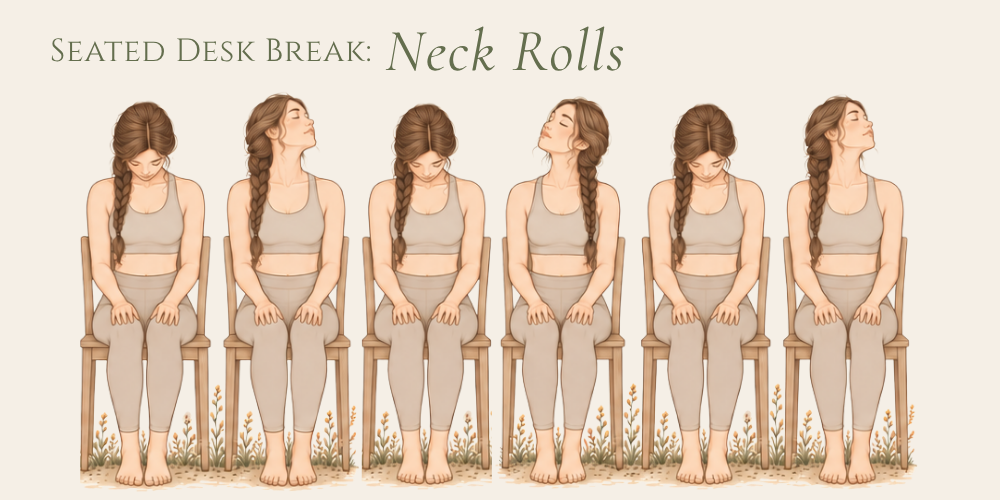
How to practice - Neck Rolls
Neck Rolls target the cervical spine and upper trapezius — the muscles that bear the weight of screen time, forward head posture, and the quiet tension of holding everything together. A few slow rolls in each direction is often all it takes to feel the difference.
-
Find your base
Sit tall in your chair with feet flat on the floor and shoulders relaxed away from your ears. -
Drop and breathe
Drop your right ear toward your right shoulder and breathe into the left side of your neck. Don't force it — let gravity do the work.Roll slowly forward
Slowly roll your chin toward your chest and over to the left side, pausing anywhere that feels tight or tender.Complete the circle
Continue rolling in a full slow circle, staying with any spots that need more time.Switch directions
Complete 3–5 rolls in each direction, breathing steadily throughout.
Move 2
Shoulder Rolls
Shoulder Girdle · Upper Trapezius
How to practice - Shoulder Rolls
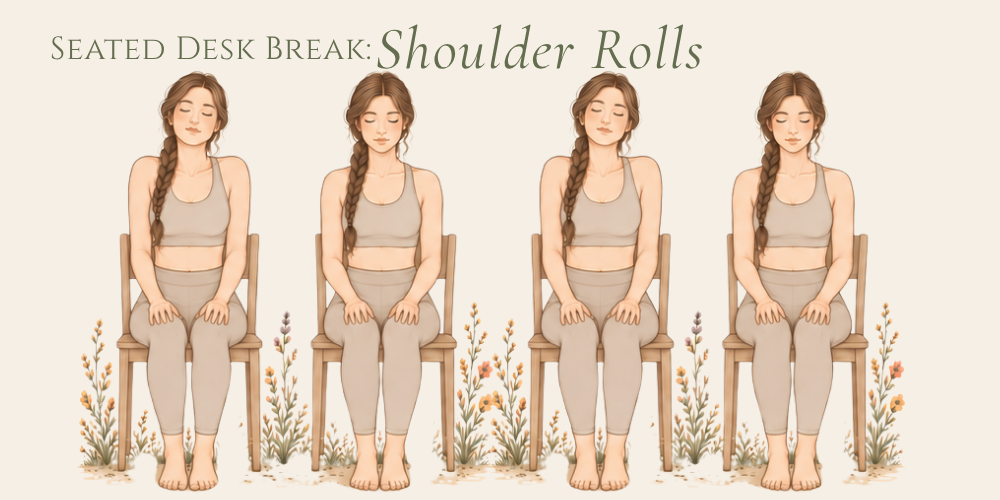
Shoulder Rolls mobilize the shoulder girdle and release the upper trapezius — the muscle that reflexively contracts when we're stressed, focused, or cold. Most people don't realize how high their shoulders have crept until they consciously roll them back and down and feel the release.
-
Find your base
Sit tall with feet flat on the floor and arms relaxed by your sides. -
Inhale — lift
Inhale and draw both shoulders up toward your ears as high as they'll go.Exhale — roll back
Exhale and roll them back and down in a slow deliberate circle, feeling the shoulder blades draw together at the back of the movement.Complete the rolls
Complete 5 rolls backward, feeling the chest open with each one.Reverse
Repeat 5 rolls forward, feeling the upper back round and release.
Move 3
Seated Twist
Thoracic Spine · Facet Joints
How to practice - Seated Twist
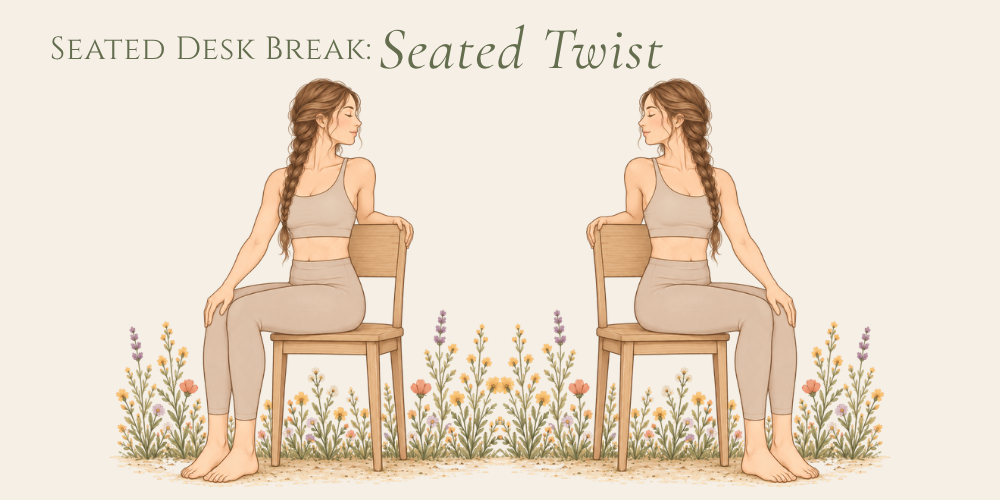
Seated Twist decompresses the thoracic spine — the middle and upper back that carries the tension of sitting in one position for hours — while also mobilizing the facet joints that stiffen when we stop rotating. The twist comes from the thoracic spine, not the lower back, which is a distinction worth practicing.
-
Find your base
Sit tall in your chair with feet flat on the floor, hip-width apart. -
Inhale — lengthen
Inhale and grow taller through the crown of your head, creating space between each vertebra.Exhale — twist right
Exhale and rotate your torso to the right, placing your left hand on your right knee and your right hand on the back of your chair.Stay long and square
Keep your hips square to the front and your spine long. The twist originates from your thoracic spine — your lower back stays neutral.Switch sides
Hold for 3–5 breaths, then inhale back to center and repeat on the opposite side.
Move 4
Wrist & Finger Stretches
Wrists · Forearms · Fingers
How to practice Wrist & Finger Stretches
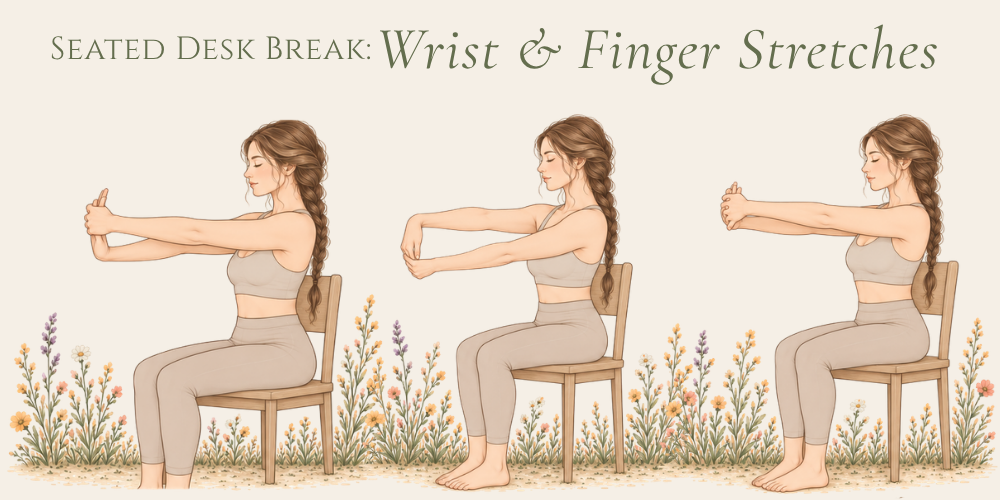
The wrists and fingers are the most overlooked part of the desk worker's body — carrying every keystroke, every scroll, every tap — and the last to receive any dedicated attention. A few minutes of wrist and finger work can make a meaningful difference in how the hands feel by end of day, and is worth building into the routine before tightness becomes pain.
-
Wrist flexion stretch
Extend one arm forward with palm facing up. Gently pull your fingers back toward you with the opposite hand. Feel the stretch through the underside of your wrist and forearm. Hold for 3–5 breaths. -
Wrist extension stretch
Flip your palm to face down and gently curl your fingers toward the floor with the opposite hand. Feel the stretch across the top of the wrist. Hold for 3–5 breaths. -
Thumb stretch
Extend your arm forward and use the opposite hand to gently pull your thumb back away from your fingers. Hold for 3–5 breaths. -
Finger spread — prayer hands
Press your palms together at your chest, fingers wide and pointing upward. Hold for 3–5 breaths and feel the gentle stretch through the fingers and forearms. -
Switch sides
Repeat all four stretches on the opposite hand before finishing.
Putting it together
Your full desk break practice
Five minutes. That's what this took. And if you actually paused on the neck rolls where something was tight, if you felt your shoulders land lower after the third backward roll, if the seated twist found something that needed to move — then it worked.
The body doesn't need long sessions to feel better. It needs consistent small interventions. This sequence is designed to be done whenever you've been sitting for more than an hour — before a meeting, after a call, at the end of a long afternoon, in the carpool line with five minutes before pickup. Bookmark it. Come back to it. Your neck will thank you.
🌿From Root & Rise in September
If you want the complete reset, pair this desk break sequence with the Root & Rise Standing Hamstring Flow — Half Lift, Forward Fold, Triangle, and Pyramid done in sequence when you have fifteen minutes to stand and move. The desk break addresses what sitting does to the neck and upper body. The standing flow addresses what it does to the legs. Together they cover the whole picture.
"You don't manage time better by doing more. You manage it better by knowing when to stop and give your body what it needs."
Plant your feet.
Open toward the light.
This is how we grow.
A deep breath in a beautiful life.
Talk soon.
— Britt
The Wildflower Journal![The 5-Minute Desk Break — Root & Rise]()
![What All That Sitting Has Been Doing to Your Legs — Root & Rise September 2026]()



Three weeks ago I started a run club. One Saturday nobody came. The surface version of that morning was fine — we went to the coffee shop, it was lovely. The underneath version is what I've been sitting with since. On loneliness, the village shrinking, and what it looks like to finally stop moving past the fear long enough to be with it for five breaths.