Root & Rise · September 2026
What All That Sitting Has Been Doing to Your Legs
A four-pose standing hamstring flow for the body that's been sitting too long — built to be done in sequence, in order, whenever you have fifteen minutes and a few feet of space.

• • •
4 weeks ✦ Time Management & Productivity ✦ Hamstrings
In this guide
Introduction Week 1 — Pause · Half Lift (Ardha Uttanasana) · Advanced: Half Lift with Fingertip Floor Touch Week 2 — Release · Standing Forward Fold (Uttanasana) · Advanced: Forward Fold with Hands Clasped Behind Back Week 3 — Shift · Triangle Pose (Trikonasana) · Advanced: Revolved Triangle Week 4 — Restore · Pyramid Pose (Parsvottanasana) · Advanced: Pyramid with Reverse Prayer Hands Your September Practice — Weekly rhythm & full sequence Pair with this month's Bloom Within breathwork →
September is a sitting month. The school year returns, the schedule fills back in, and suddenly the body is spending long hours at a desk, in a car, in the carpool line — places where the hamstrings shorten, the hip flexors grip, and the posterior chain quietly forgets what length feels like.
This flow was built for that body. Four standing poses, practiced in sequence, that move from gentle awakening to deep single-leg work. Half Lift warms the hamstrings and establishes the flat-back position the rest of the sequence builds from. Forward Fold asks you to surrender into gravity. Triangle shifts the angle and hits the outer hamstring in a way the forward folds can't reach. And Pyramid closes the sequence with the most precise, intense hamstring work of the four.
You don't need a mat, a studio, or a lot of time. You need about fifteen minutes and a few feet of space. The sequence works as a standalone practice and pairs well with the 5-Minute Desk Break flow if you want the full September reset.
The through line
The hamstrings shorten from sitting. They lengthen from attention. This sequence gives them that attention in four stages — warming, surrendering, shifting, and restoring — so the body that's been carrying the weight of a full September schedule gets something back by the end of it.
Week 1
Pause
Half Lift (Ardha Uttanasana) · Advanced: Half Lift with Fingertip Floor Touch
"The pause is not the opposite of productivity. It is the beginning of it."
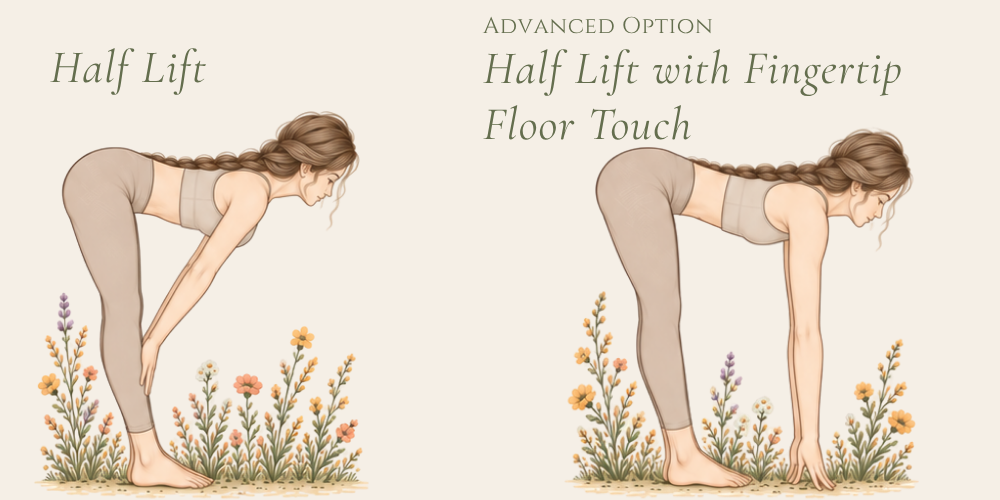
How to practice - Half Lift
Half Lift (Ardha Uttanasana) is the foundation of the sequence — a gentle awakening of the posterior chain that establishes the flat-back position every other pose builds from. It's subtle but precise, and doing it well makes everything that follows more effective. The tendency is to rush past it toward the full fold. Don't. This is where the hamstrings actually wake up.
-
Find your base
Stand with feet hip-width apart and fold forward from your hips, letting your upper body hang. -
Place your hands
Place your hands on your shins and inhale to lengthen your spine. For the advanced option, walk your fingertips to the floor while maintaining the flat back position. The hamstrings deepen as the fingertips descend — don't round the spine to reach the floor. The goal is length, not proximity to the ground.Lift and lengthen
Draw your shoulders back and down, lift your chest away from the floor, and extend your crown forward. Your back should be flat — not rounded, not overarched.Hold and breathe
Hold for 3–5 breaths, keeping your hamstrings engaged and your back flat throughout.Release
Exhale and fold back down before moving into the next pose.The reflection
Before you can lengthen something, you have to find where it starts. Half Lift is exactly that — a moment of honest inventory. Where is the tightness? Where does the back want to round instead of extend? Where are you rushing? The pause here isn't passive. It's the most important thing you do in the whole sequence.
"The pause is not the opposite of productivity. It is the beginning of it."
This week's reflection prompt
Where in my day am I moving so fast I haven't noticed what my body needs?
Week 2
Release
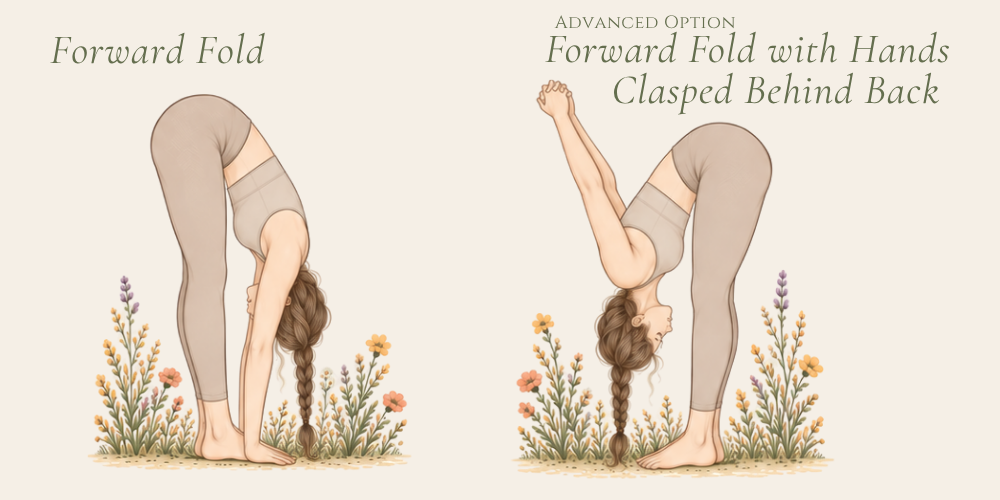
Standing Forward Fold (Uttanasana) · Advanced: Forward Fold with Hands Clasped Behind Back
"Release is not a reward for finishing. It is how you keep going."
How to practice - Standing Forward Fold (Uttanasana) · Advanced: Forward Fold with Hands Clasped Behind Back
Standing Forward Fold (Uttanasana) is where gravity becomes your teacher. After the precise, engaged quality of Half Lift, the fold asks you to surrender — to let the upper body hang completely heavy and trust that release is productive too. It's the longest hamstring stretch in the sequence and the one most people rush past.
-
Find your base
Stand with feet hip-width apart and hinge forward slowly from your hips. For the advanced option, clasp your hands behind your back before folding. -
Hang heavy
Let your upper body hang completely, knees soft, neck fully released. Don't try to touch the floor — just hang.Hold opposite elbows
Hold opposite elbows and let the weight of your arms deepen the release through your upper back and hamstrings. For the advanced option, let your clasped hands fall away from your lower back toward the ceilingSway and breathe
Sway gently side to side if that feels good. Breathe into the backs of your legs and let gravity do the work.Stay
Hold for 5–8 breaths — longer than feels strictly necessary. The hamstrings release in layers.The reflection
The body that's been bracing all day needs somewhere to put it down. Forward Fold is that somewhere. Not a destination to achieve, not a depth to reach — just a letting go that happens breath by breath. The hamstrings don't release on command. They release when you stop bracing long enough to let them.
"Release is not a reward for finishing. It is how you keep going."
This week's reflection prompt
What am I still holding in my body that I no longer need to carry?
Week 3
Shift
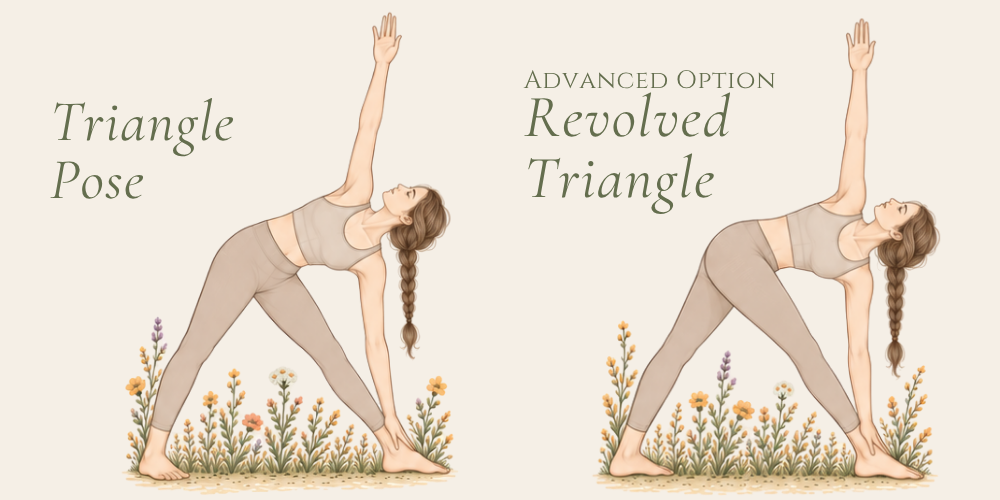
Triangle Pose (Trikonasana) · Advanced: Revolved Triangle
"A different angle changes everything. The problem is the same. But the view from here is entirely new."
How to practice - Triangle Pose (Trikonasana) · Advanced: Revolved Triangle
Triangle Pose (Trikonasana) introduces a lateral element to the sequence — a sideways reach that targets the outer hamstring, IT band, and hip in a way the forward-folding poses can't access. It's the pose in this sequence that most clearly demonstrates that a different angle changes the experience entirely. Same legs, same body, completely different stretch.
-
Find your base
Stand with feet wide apart — about 3–4 feet. Turn your right foot out 90 degrees and your left foot slightly in. -
Extend your arms
Extend your arms to a T at shoulder height, one pointing toward each end of the room.Hinge sideways
Hinge sideways over your right leg, reaching your right hand toward your shin, ankle, or the floor — wherever feels right without collapsing the side body.Reach up and gaze
Reach your left arm straight up toward the ceiling and let your gaze follow. Feel the stretch run from your outer right hip all the way through your side body.Switch sides
Hold for 5–8 breaths and repeat on the opposite side. For the advanced option: from Triangle, bring both hands to the floor on either side of your front foot. Inhale to lengthen, then exhale and reach your top arm toward the ceiling, stacking your shoulders. Keep your back leg strong and your hips as square as possible. A deeper rotation, a stronger challenge.The reflection
The forward folds in this sequence work with gravity. Triangle works against the grain — sideways, into a direction the body doesn't usually go, which is why it finds tightness the others miss. When something isn't moving, the answer is rarely more of the same direction. Sometimes you just need a different angle.
"A different angle changes everything. The problem is the same. But the view from here is entirely new."
This week's reflection prompt
Where in my work or life do I need to stop pushing harder and start looking from a different angle?
Week 4
Restore
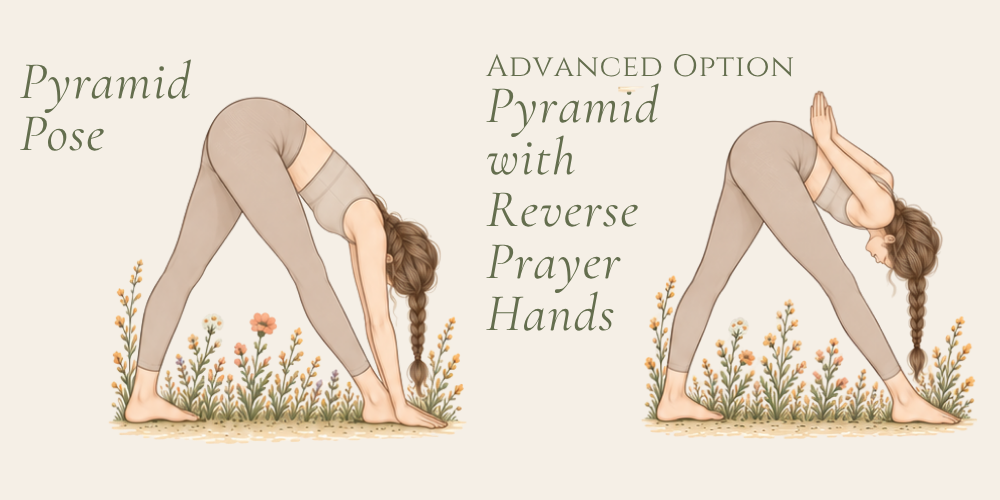
Pyramid Pose (Parsvottanasana) · Advanced: Pyramid with Reverse Prayer Hands
"Restoration is not the absence of productivity. It is the practice that makes everything else sustainable."
How to practice Pyramid Pose (Parsvottanasana) · Advanced: Pyramid with Reverse Prayer Hands
Pyramid Pose (Parsvottanasana) is the most intense single-leg hamstring stretch in the sequence — a deep, precise fold over one leg at a time that requires the hips to stay square and the spine to stay long. It closes the flow with the strongest hamstring work of the four, which means it also asks the most of your patience and your willingness to stay.
-
Find your base
Stand with feet staggered — right foot forward, left foot back at a 45-degree angle. Your feet should be about 2–3 feet apart. -
Square your hips
Square both hips toward the front of the room. This is the key alignment point — the left hip will want to open; keep drawing it forward. -
Hinge and fold
Inhale to lengthen your spine, then exhale and hinge forward from your hips over your front leg. Let your hands rest on your shin, a block, or the floor. For the advanced option, Bring your hands behind your back and press your palms together in reverse prayer — fingers pointing upward. If reverse prayer isn't accessible, hold opposite elbows instead. Keep your chest open as you fold, letting the arm position deepen the shoulder and chest stretch simultaneously. -
Breathe into the hamstring
Keep your front leg as straight as possible and breathe directly into the back of your right thigh. Stay for 5–8 breaths, letting the hamstring release with each exhale. -
Switch sides
Slowly return to standing, switch your footing, and repeat on the opposite side.
The reflection
Pyramid asks you to be specific about where the body is holding and precise about how you release it. There's no swaying, no momentum, no gravity doing the heavy lifting. Just one leg, fully lengthened, and the patience to stay with it. By the time you finish both sides, the sequence is complete — and the hamstrings have been given back something that a day of sitting took from them.
What does my body need to restore before the next season begins?
This week's reflection prompt
What does my body need to restore before the next season begins?
Putting it together
Your September practice
Practice these four poses in order, ideally with a few breaths of transition between each. The full sequence takes about 12–15 minutes. It builds deliberately from gentle to deep — don't skip the Half Lift at the start, and don't rush Pyramid at the end.
🌿From Bloom Within this month
If September's theme of time management & sustainable productivity is resonating, the Harvest Focus Breath breathwork & the Afternoon Activation breathwork in Bloom Within were written exactly for this — moments when the schedule feels unmanageable and the body needs a reset that goes deeper than a stretch. The two practices work well together as a complete five-minute break.
"You cannot think your way into a calmer nervous system. But you can breathe your way there."
Plant your feet.
Open toward the light.
This is how we grow.
A deep breath in a beautiful life.
Talk soon.
— Britt
The Wildflower Journal![The 5-Minute Desk Break — Root & Rise]()
![What All That Sitting Has Been Doing to Your Legs — Root & Rise September 2026]()

Three weeks ago I started a run club. One Saturday nobody came. The surface version of that morning was fine — we went to the coffee shop, it was lovely. The underneath version is what I've been sitting with since. On loneliness, the village shrinking, and what it looks like to finally stop moving past the fear long enough to be with it for five breaths.