Root & Rise · August 2026
Opening Yourself to Others
Four weeks of movement and reflection — built around what it means to make yourself available, extend toward others, embrace what you find, and return to yourself.

• • •
4 weeks ✦ Relationships & Connections ✦ Heart & Arms
In this guide
Introduction Week 1 — Invitation · Cactus Arms · Advanced: Standing Backbend Cactus Arms Week 2 — Extend · Overhead Tricep Stretch · Advanced: Cow Face Arms Week 3 — Embrace · Eagle Arms · Advanced: Full Standing Eagle Pose Week 4 — Return · Ragdoll Forward Fold · Advanced: Eagle Arms into Ragdoll Forward Fold Your August Practice — Weekly rhythm & full sequence Pair with this month's Bloom Within breathwork →There's a phrase I've been sitting with all summer: to live in a village, you have to be a good villager. Not just a recipient of community — an active participant in it. Someone who shows up, opens up, and makes themselves genuinely available to the people around them.
That sounds straightforward until you actually try to do it. Opening up to people requires something of you before you know whether it's going to be worth it. You have to make yourself available before the connection is guaranteed. You have to stand there — or in the case of this month's movement, reach, extend, embrace — and trust that it isn't a mistake.
August's Root & Rise works through the chest, arms, and upper back — the places that physically carry the weight of connection and the tension of keeping people at a distance. Four poses, four weeks, one theme: what does it feel like in the body to genuinely open yourself to others? And what does it feel like to remember that the village includes you too?
The through line
Connection begins before a single word is spoken. It begins with a posture — with the body's decision to be available or defended, open or closed. This month we practice opening. And at the end, we practice coming home.
Week 1
Invitation
Cactus Arms · Advanced: Standing Backbend Cactus Arms
"Connection begins before a single word is spoken."
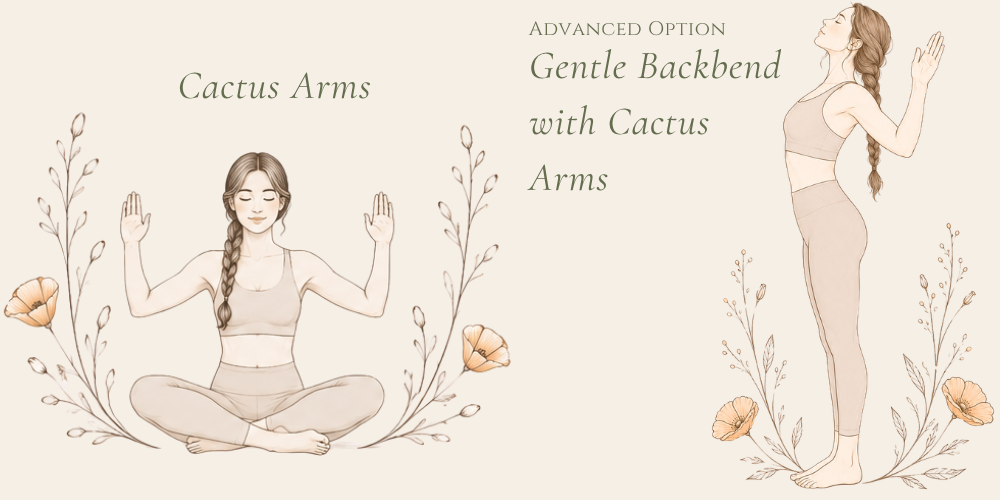
How to practice - Cactus Arms
Cactus Arms opens the chest and front shoulders — the muscles that round forward and close off when we're stressed, tired, or simply going through the day without thinking about posture. It's a deceptively simple shape that creates an immediate and tangible sense of openness. Most people feel the difference in a single breath.
-
Find your base
Stand tall or sit upright with feet grounded and spine long. -
Raise and bend
Raise both arms to shoulder height and bend your elbows to 90 degrees, palms facing forward.Draw back and open
Gently draw your shoulder blades together and down, opening your chest wide.Hold and breathe
Hold the shape and breathe — let your chest expand with each inhale rather than bracing against the stretch.Stay
Hold for 5–8 breaths. Notice who comes to mind when you hold your body in this shape.How to practice - Advanced Option · Standing Backbend Cactus Arms
Standing Backbend Cactus Arms takes the open-armed invitation of the primary pose and lifts it — literally. Where Cactus Arms says I'm here, I'm open, the backbend says I'm willing to be fully seen. The chest rises toward the ceiling, the heart opens upward, and for a moment the whole front body is exposed in a way that feels slightly vulnerable and completely intentional. That's the deeper layer of Invitation: not just making yourself available, but being willing to be visible in the process.
-
Find your base
Stand tall with feet hip-width apart and arms in Cactus position — elbows bent to 90 degrees, palms facing forward -
Press and lift
Press your hips gently forward and begin to lift your chest toward the ceilingHold your shape
Keep your arms strong in their Cactus position as your heart opens upwardFollow your head
Let your head follow only as far as feels comfortable — no strain in the neckHold and return
Hold for 3–5 breaths, then slowly return to standing on an inhaleThe reflection
Cactus Arms is the body's way of saying: I'm here. I'm open. Come closer. Before the conversation, before the vulnerability, before any of the hard relational work — there's a posture. The way you hold yourself tells people whether there's room for them before you've said a word.
This month we're starting with the most literal version of that invitation. Arms open, chest available, the whole front body exposed to whatever — and whoever — is in front of you. It's almost embarrassingly simple. It's also exactly what genuine availability looks like.
"You cannot build a village from behind closed arms."
This week's reflection prompt
Who am I making myself available to — and who have I been too closed off to reach?
Week 2
Extend
Overhead Tricep Stretch · Advanced: Cow Face Arms
"The reach is the relationship."
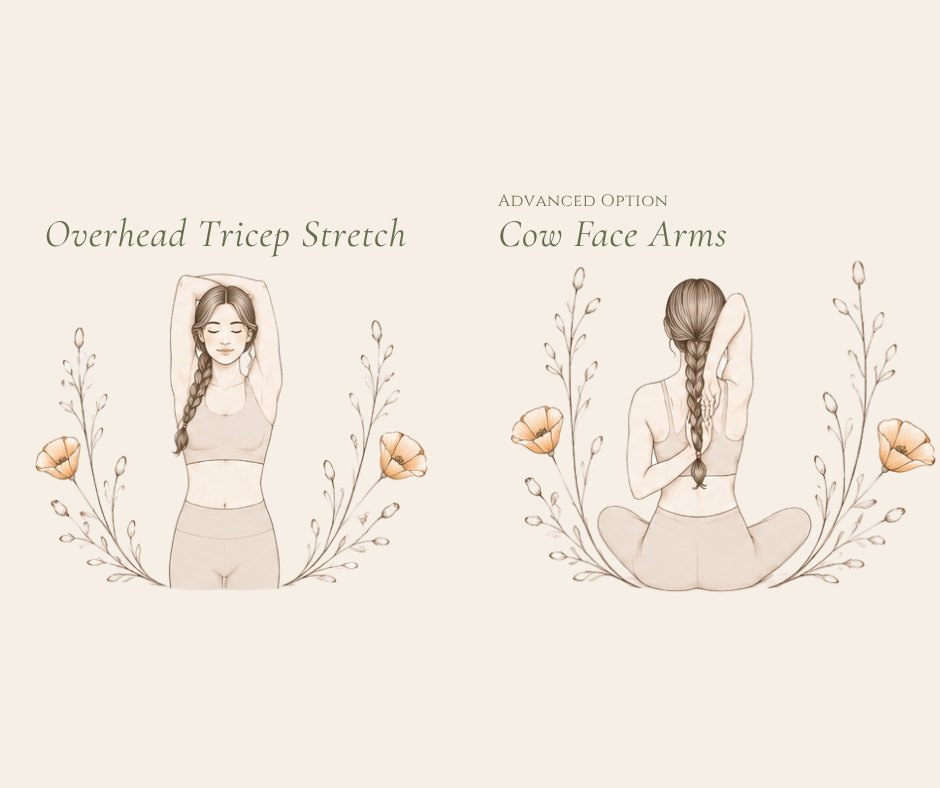
How to practice - Overhead Tricep Stretch
The Overhead Tricep Stretch is a quiet, inward lengthening through the back of the arm and the posterior shoulder. It doesn't look like much from the outside. That's rather the point — most of the real work of extending yourself toward others doesn't look like much from the outside either.
-
Find your base
Sit or stand tall with feet grounded and spine long. -
Raise one arm
Raise one arm overhead, lengthening through the fingertips.Bend and drop
Bend your elbow and let your hand drop behind your head, between your shoulder blades.Guide gently
Use your opposite hand to gently guide your elbow inward, lengthening through the back of the arm without forcing the stretch.Switch sides
Hold for 3–5 breaths, then repeat on the opposite side.How to practice - Advanced Option · Cow Face Arms
Cow Face Arms asks something the Overhead Tricep Stretch doesn't — it asks both arms to reach simultaneously, in opposite directions, and find each other somewhere in the middle of the back. One arm overhead, one arm behind, hands clasped or reaching toward each other across the distance. It's the most literal physical expression of Week 2's theme: two people extending toward each other at the same time, meeting somewhere neither could reach alone. The surrender required — especially in the shoulder that resists — is exactly what it feels like to reach first and stay open while you wait.
-
Reach overhead
Raise your right arm overhead and bend your elbow, letting your hand drop between your shoulder blades -
Reach behind
Reach your left arm behind your back and bend it upward, working your fingers toward your right handConnect
If your hands meet, gently clasp them — if not, hold a strap or towel between themStay open
Keep your chest open and your spine long throughoutSwitch sides
Hold for 3–5 breaths, then release and repeat on the opposite sideThe reflection
Nobody reaches first by accident. Extending yourself toward someone — making the call, sending the message, showing up when it would be easier not to — is a choice every single time. And it's not always a comfortable one. Reaching first means accepting that the other person might not reach back.
The Overhead Tricep Stretch is a reach behind yourself — arm overhead, elbow bent, hand dropped toward a place you can't quite see. That's exactly what it feels like to extend toward someone when you've been waiting too long. You can't fully see where it's going. You reach anyway.
"The reach is the relationship. You don't wait to feel ready — you extend first and let the connection catch up."
This week's reflection prompt
Where in my relationships am I waiting for someone else to reach first?
Week 3
Embrace
Eagle Arms · Advanced: Full Standing Eagle Pose
"To embrace someone fully, you have to be willing to close the distance."
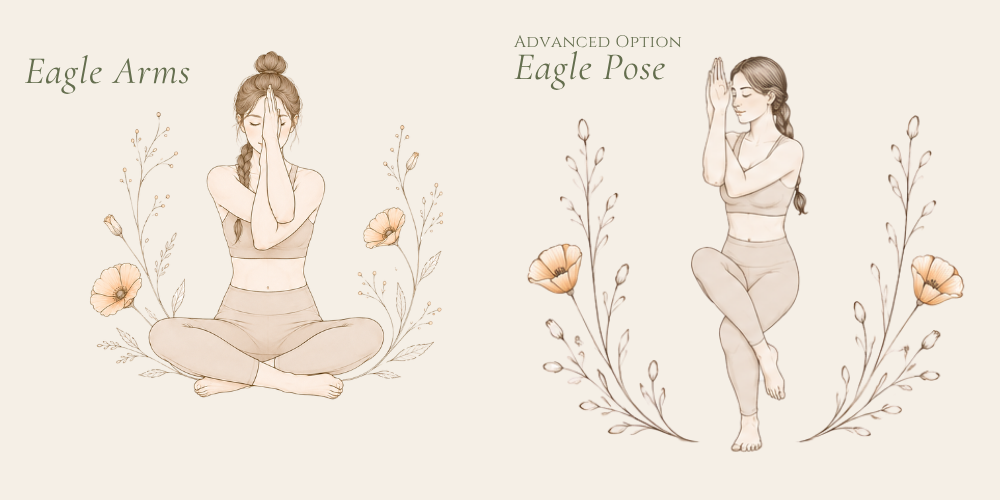
How to practice - Eagle Arms
Eagle Arms targets the upper back and posterior shoulders in a way most stretches can't reach — because the crossing of the arms creates a traction that pulls the shoulder blades apart, opening the space between them. If you carry tension between your shoulder blades, this one will find it immediately. And it will ask something of you: close in to open up.
-
Find your base
Sit or stand tall and extend both arms in front of you at shoulder height. -
Cross and wrap
Cross your right arm under your left and bend both elbows, wrapping your forearms and working your palms toward each other.Lift and draw
Lift your elbows to shoulder height and draw them slightly away from your chest.Feel the opening
Feel the stretch open across your upper back and between your shoulder blades. Notice how closing in creates an opening in the back.Switch sides
Hold for 5–8 breaths and repeat with the opposite arm on top.How to practice - Advanced Option · Full Standing Eagle Pose
Full Standing Eagle Pose adds everything Eagle Arms has — the binding, the wrapping, the opening across the upper back — and then asks you to balance on one leg while you hold it. The bind stays the same. The ground beneath you gets smaller. And that's exactly the point: an embrace in real life rarely arrives under perfect conditions. You close the distance while other things are uncertain, while you're not completely stable, while you can't fully predict what will happen next. Eagle Pose asks you to hold the shape anyway — arms wrapped, gaze fixed, standing on one foot and trusting it's enough.
-
Find your base
Stand tall and shift your weight into your left foot -
Cross your legs
Cross your right thigh over your left and hook your right foot behind your left calfCross your arms
Cross your left elbow over your right and wrap your forearms, working your palms toward each otherLift and sink
Lift your elbows to shoulder height, sink your hips, and find your gaze at one fixed pointSwitch sides
Hold for 5–8 breaths, then release and repeat on the opposite sideThe reflection
An embrace asks you to close the distance. Not approach it, not circle it, not think about closing it the next time you see someone. Close it now. Cross your arms, bind your forearms, and lift. You give up some of your freedom of movement in order to feel something new. That trade is what an embrace actually is.
We've spent two weeks opening up and reaching out. This week we practice what happens when you actually arrive — when the distance closes and you find yourself in contact with another person, another idea, another version of yourself.
"An embrace asks you to close the distance — to bind yourself, even briefly, to something outside yourself."
This week's reflection prompt
What would it feel like to hold someone — or something — a little closer this week?
Week 4
Return
Ragdoll Forward Fold · Advanced: Eagle Arms into Ragdoll Forward Fold
"The relationship with yourself is the one you'll have the longest."
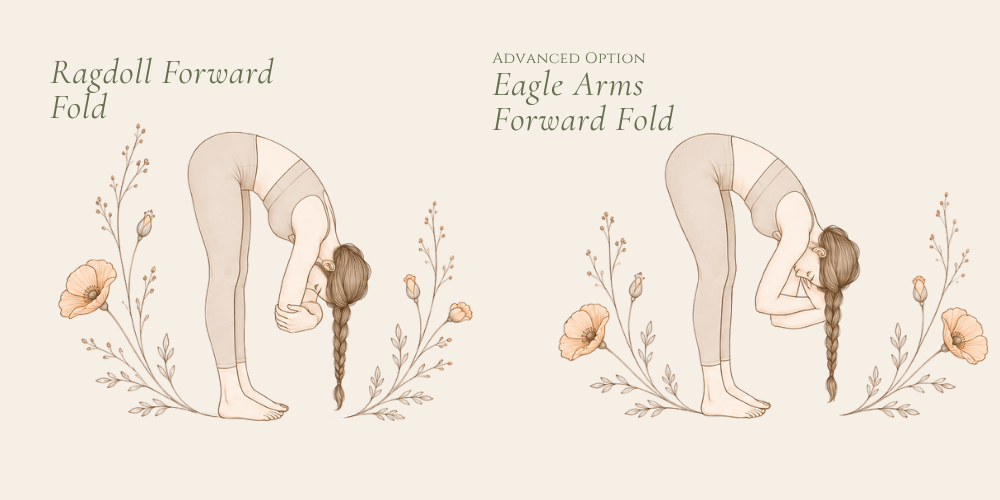
How to practice Ragdoll Forward Fold
Ragdoll Forward Fold is a complete release — upper body hanging heavy, arms wrapped or dangling, neck fully released, gravity doing all the work. After three weeks of reaching outward, it's the month's exhale. An invitation to let yourself be held, even if only by your own arms and the pull of the earth.
-
Find your base
Stand tall with feet hip-width apart. -
Fold forward
Inhale to lengthen through your spine, then exhale and fold forward from your hips, letting your upper body hang heavy. -
Hold your elbows
Wrap your opposite hands around your elbows — right hand to left elbow, left hand to right — and let your arms dangle. -
Release completely
Breathe directly into your upper back and between your shoulder blades. Feel the space between them expand with each inhale. -
Stay and breathe
Release your neck completely, let your head be heavy, and sway gently side to side if that feels good.
HOW TO PRACTICE — Advanced Option · Full Standing Eagle Pose
Eagle Arms into Ragdoll Forward Fold combines the month's third week with its fourth — the embrace folding into the return. You bind your arms the way you did in Week 3, and then you fold forward and let the whole shape hang. The upper back opens more deeply than a standard ragdoll because the arms create traction as they dangle. It's the most complete version of what this month has been practicing: you close in, you hold on, and then you let gravity take the weight of it. The relationship with yourself doesn't require you to hold everything upright all the time. Sometimes returning to yourself looks like folding forward with your arms wrapped and your head completely heavy, trusting that the floor will catch you.
-
Cross and wrap
From standing, cross your right arm under your left and bend both elbows, wrapping your forearms and working your palms toward each other -
Lift and fold
Lift your elbows to shoulder height, then exhale and fold forward from your hips -
Hang heavy
Let your eagle arms hang heavy as you fold, breathing into the space between your shoulder blades -
Release completely
Keep your knees soft and your neck fully released -
Switch sides
Hold for 5–8 breaths, then slowly roll back up and repeat with the opposite arm on top
The reflection
All month we've been opening outward — arms wide, chest available, distance closed. This week we turn that same energy inward. Because a village includes you. The relationship you have with yourself is the one you'll carry the longest, tend to the most quietly, and neglect the most easily when life gets full of other people's needs.
Ragdoll Forward Fold doesn't ask anything of you. It asks you to stop asking anything of yourself, just for a few breaths. Let your arms hang. Let your head be heavy. Let gravity hold you for once, instead of the other way around.
"The relationship with yourself is the one you'll have the longest. Tend to it like it matters — because it does."
This week's reflection prompt
How well am I nurturing the most important relationship I have — the one with myself?
Putting it together
Your August practice
If you're coming to this guide partway through the month — or returning to it after August has passed — here are two ways to move through these four practices.
As a weekly rhythm
Cactus Arms Daily, 5–8 breaths. Try it standing before you walk into a room where you want to be fully present — before a gathering, a difficult conversation, or even just a regular Tuesday. Notice what changes in your posture when you hold the shape.
Overhead Tricep Stretch 3–4 times across the week, 3–5 breaths per side. Pair it with the reflection question. Notice the quality of the reach — not expansive, not dramatic, just steady. That's the point.
Eagle Arms Morning or evening, 5–8 breaths per side. Pay attention to how closing in creates opening in the upper back. Let the physical sensation remind you what an embrace costs and what it gives back.
Ragdoll Forward Fold Morning or evening, 5–8 breaths. This is the month's exhale. Don't rush it. Let your neck be completely released and your arms completely heavy. You've been opening outward all month — this week, just hang.
As a single flowing sequence
If you want to move through all four in one sitting, this is the order. It builds naturally from opening to reaching to turning to releasing — about 12–15 minutes total.
From Bloom Within this month
If August's theme of opening yourself to others is resonating, the Softening Toward Another breathwork in Bloom Within was written for the moments when connection feels hard — when vulnerability feels risky and the body wants to close rather than open. The two practices work well together.
"The most generous thing you can offer another person is your genuine presence. Breathwork is how we clear the way for that."
Plant your feet.
Open toward the light.
This is how we grow.
A deep breath in a beautiful life.
Talk soon.
— Britt

Three weeks ago I started a run club. One Saturday nobody came. The surface version of that morning was fine — we went to the coffee shop, it was lovely. The underneath version is what I've been sitting with since. On loneliness, the village shrinking, and what it looks like to finally stop moving past the fear long enough to be with it for five breaths.