On Watching the Women Play
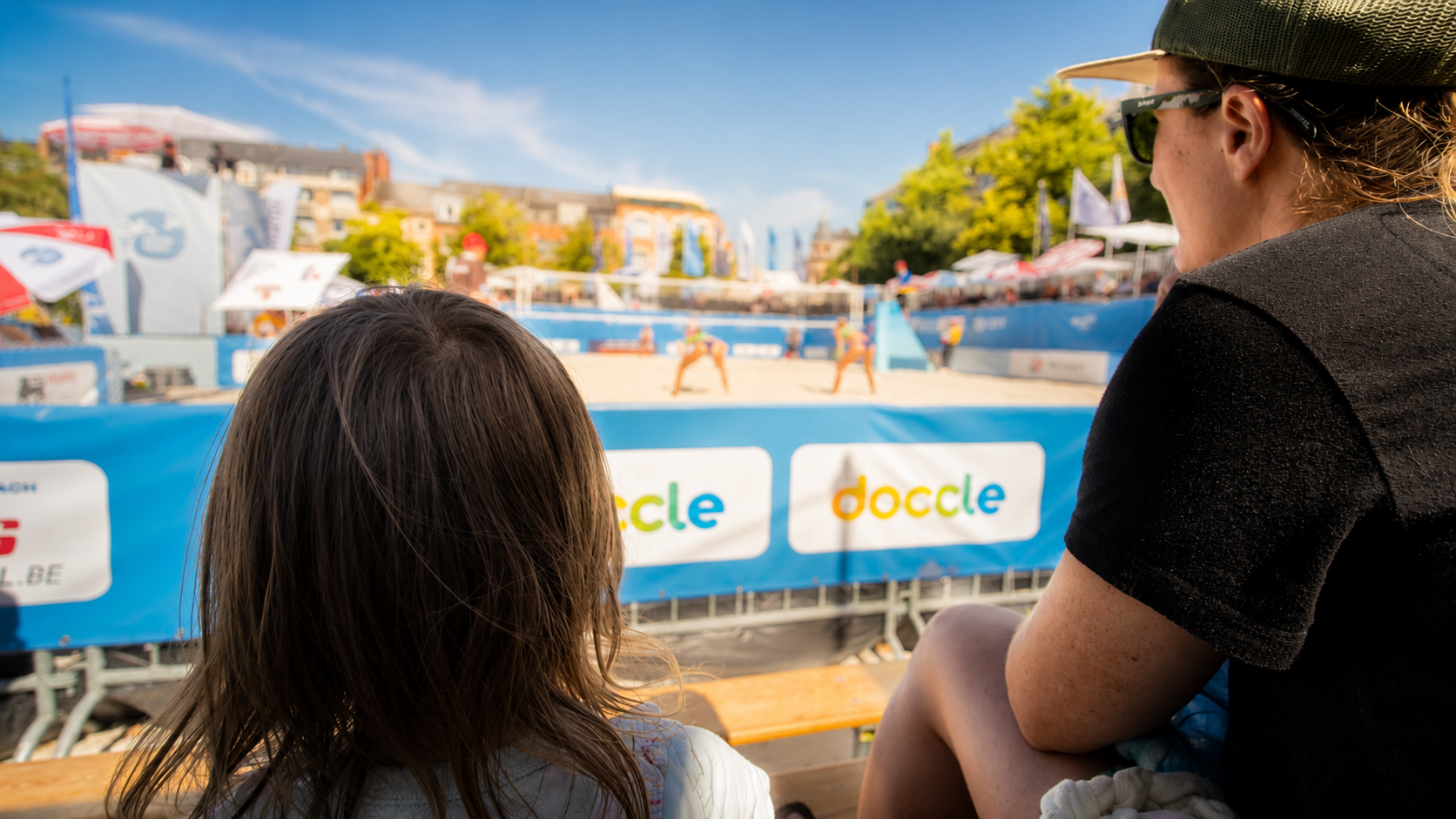
I was sitting in the bleachers on the edge of a beach volleyball court when I wrote this in my head. Not on my phone, not in my notebook — just in that particular way you store something when you know it needs to come out eventually. My daughter was next to me, watching. And I thought: I want her to keep watching. Eventually it was time for her to head home for nap time, so my husband took her home to bed and I continued watching the athletes playing beach volleyball. That’s when I finally took out my phone and started jotting down all my thoughts because they just had to come out.
Let me back up.
We've had two international sports events come through our city this summer. Two. And my daughter — who is at an age where she absorbs everything, files it somewhere, and pulls it back out in ways that surprise me — watched only the women compete in both of them. Not because I engineered it, not because I sat down and decided to make a values statement out of our social calendar. It happened because the women's events were the ones scheduled during the windows that didn't completely blow-up nap time and bedtime. A happy accident that I am not even a little bit sorry about.
But it made me think. And once something makes me think like this, it tends to become a letter to you, so here we are.
There's a lot of conversation — a lot — about why women's sports get less television coverage, why the athletes are paid less, why the arenas are smaller, why the audiences are thinner. And the people doing the rationalizing always have a reason. Market forces. Viewership numbers. Revenue. As if value is only ever a number with a dollar sign in front of it.
What we talk about less — almost never, actually — is the argument for why women's sports might matter more. Not equally. More. At least when it comes to what they do for the next generation.
There's research out there — talk more about this in another letter — on what happens to children when their mothers are active versus when only their fathers are. The short version, from what I understand, is that a mother's relationship with her own body and movement has an outsized effect on whether her children — especially her daughters — develop one of their own. When kids watch their moms move, compete, sweat, push, rest, and come back, something gets wired in. A template. A belief about what's possible for a body that looks like theirs.
So, when my daughter sits next to me and watches women serve and spike and dive in the sand and get back up and do it again — she's not just watching a sport. She's watching herself, in some future sense. She's watching a version of what her body might do someday. And that is not a small thing.
...she's not just watching a sport. She's watching herself, in some future sense.
I think about the night I met Heather.
Heather is my best friend. A lot of you know who she is from my Instagram and our podcast together — she shows up in my life in the way that real best friends do, which is to say frequently and at the most random moments. We met at a Foo Fighters concert, which tells you something about both of us. We had floor tickets, which means we were going to be standing the whole night, which also meant there were no seats to sit in while we ate. There was a pizza option — real, wood-fired pizza — and I wanted it. So, I got it. Which meant I was now holding a large open pizza box with no surface to put it on and nowhere to sit.
I looked around. Everyone was standing, holding their food, doing that awkward thing where you try to eat while pretending you don't need a table. And something in me just decided: I'm sitting on the floor and eating my pizza.
So, I did.
And within five minutes, there was a small group of us all sitting on the floor together, eating. Heather was one of them. She thanked me afterward — for sitting, she said. For doing the thing first so everyone else felt like they could too.
I've thought about that moment more times than makes any rational sense. Because what happened wasn't complicated.
Someone did the thing. And then other people believed they were allowed to do it too.
That's it. That's the whole mechanism.
When little girls watch women compete — really compete, at the highest levels, in front of crowds, on television, in folding chair arenas on the sand — something in them sits down on the floor. Something in them says: oh. I'm allowed to do that. And when little boys watch it too, something in them learns that the floor has always had room for everyone. That it was never actually a boys-only situation to begin with. That the "boys club" framing was always a choice someone made, not a law of nature.
Did I watch the men play beach volleyball this summer? Yes, of course. I'm not going to pretend I wasn't impressed. The pace of the game, the length of the rallies, the way their height lets them drive the ball straight down over the net in a way that looks almost unfair — it's genuinely exciting to watch. I'm not dismissing it.
But do I think the male athletes are more valuable to us as a society than the women?
Hard no.
And I think it's worth saying that out loud, in those exact words, because we spend so much time being careful and measured and "both sides" about this that we never actually say the thing. Value is not the same as revenue. The things that shape who our children become — the templates they absorb, the permissions they give themselves, the futures they can picture — those things do not always come with a price tag. And the fact that we've built an entire economic argument around viewership numbers while ignoring the developmental argument about what children internalize when they watch women compete — that's not a neutral oversight. That's a choice.
My daughter watched the women play this summer. Both times. Completely by accident.
I'm going to continue making it more on purpose.
Talk soon.
— Britt


I spent years being very good at exercise and having almost no idea why I was doing it outside of competition. A Division I athlete who lost her relationship with movement the moment the sport ended — and had to find her way back to it entirely on her own terms.